 Image 1 of 1
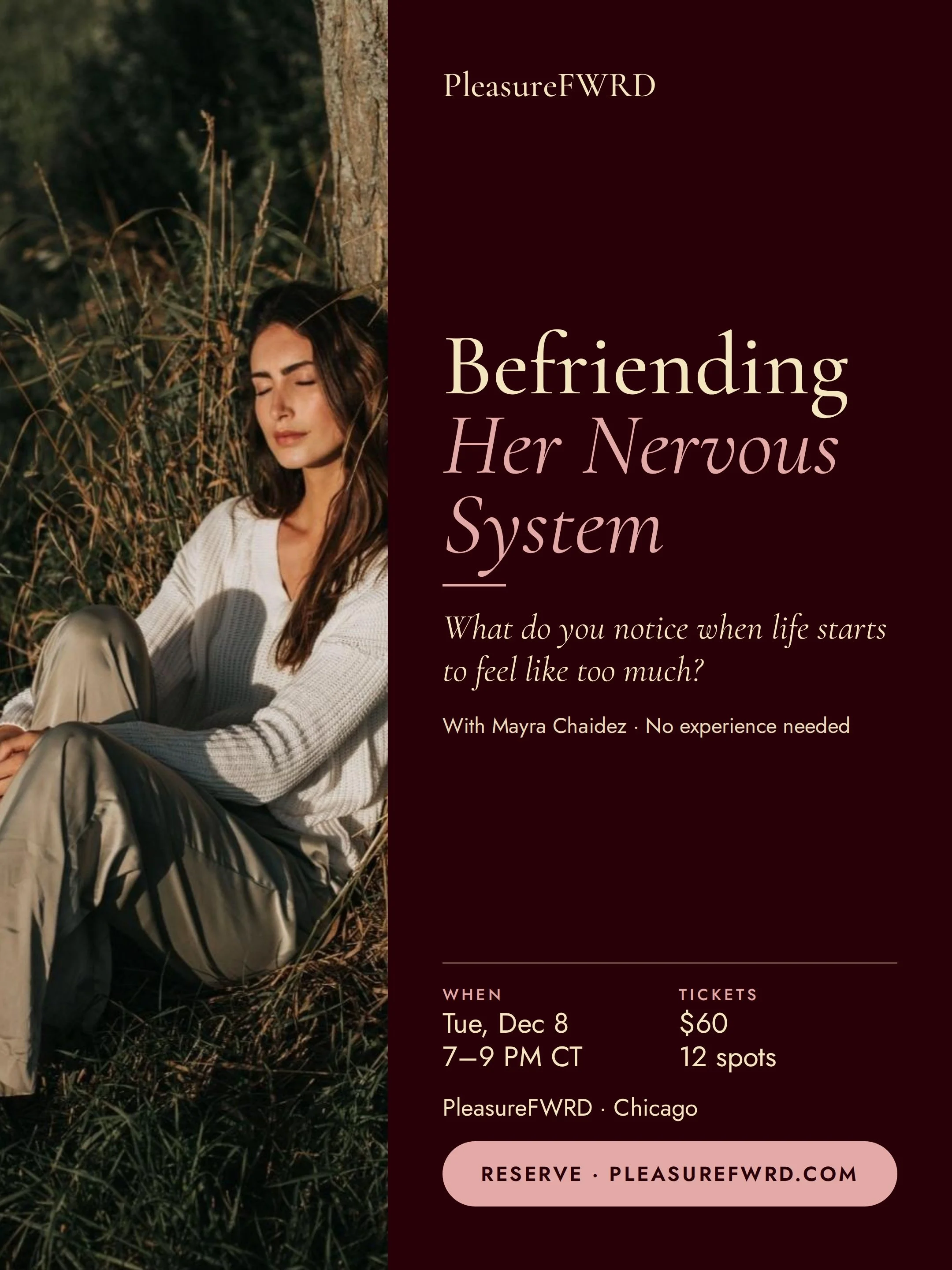
Befriending Her Nervous System | Tuesday, December 8, 2026 · 7:00–9:00 PM CT
The Experience
Understand your patterns.
Listen to your body.
Respond with greater curiosity and choice.
Your nervous system influences far more than moments of stress.
It can shape how you respond to conflict.
How you experience closeness.
How you communicate boundaries.
How you rest.
How you connect.
And how you respond when something feels overwhelming.
Many of us have spent years criticizing ourselves for being “too sensitive,” “too emotional,” “too much,” or not able to simply calm down.
But many of the reactions we judge are protective responses our bodies have learned over time.
Befriending Your Nervous System™ is an educational and experiential introduction to understanding these patterns with curiosity instead of criticism.
Rather than trying to fix or control every response, you’ll learn to recognize signals of activation, settling, connection, and shutdown—and explore practices that may help you respond with greater awareness, flexibility, and self-compassion.
Because your body is not working against you.
It is communicating with you.
You’ll Explore
🧠 Understanding Your Inner Landscape
Learn the foundations of the autonomic nervous system and explore how stress responses may influence thoughts, emotions, behaviors, attention, and relationships.
We’ll discuss commonly described protective patterns such as fight, flight, freeze, fawn, and shutdown without using them as diagnoses or fixed identities.
🌿 Recognizing Your Patterns
Explore your personal signs of activation, overwhelm, disconnection, settling, and connection through guided reflection and somatic awareness.
You may begin noticing:
Changes in breathing or heart rate
Muscle tension or restlessness
Feeling energized, alert, numb, or disconnected
Urges to argue, leave, please, hide, or shut down
Changes in your ability to communicate or make decisions
Sensations associated with comfort, connection, or ease
The goal is not to label every experience.
It is to become more familiar with your own signals.
🌬️ Practicing Supportive Responses
Explore simple breath awareness, grounding, movement, orientation, sensory practices, and body awareness.
Rather than promising to regulate your nervous system on command, these practices offer opportunities to notice what helps you feel more present, supported, and able to make choices.
Every person responds differently. You’ll be encouraged to identify what feels useful to you and leave behind what does not.
✍️ Create Your Personal Nervous-System Support Map™
Identify your individual signs of activation, settling, overwhelm, and connection.
Your map may include:
Early signals that you are becoming activated
Environments and sensory experiences that feel supportive
Movements or grounding practices you may want to try
People you can contact for connection
Boundaries that support your capacity
Signs that you may need rest or professional care
Your map is not a clinical assessment or treatment plan.
It is a personal awareness tool you can continue developing over time.
You’ll Carry Forward
A foundational understanding of the autonomic nervous system
Greater awareness of your stress and protective patterns
More compassionate language for understanding your responses
Grounding and body-awareness practices to explore
Your personalized Nervous-System Support Map™
Greater curiosity about what helps you feel present, connected, and supported
Good to Know
Length
120 Minutes
Designed For
Women and femme-aligned adults, ages 18+
Experience Level
Open to all. No previous knowledge of somatic practices or the nervous system is necessary.
Dress Code
Wear comfortable clothing that allows for gentle movement and optional floor-based practices.
What to Bring
Journal
Water bottle
Curiosity
Anything that helps you sit or rest comfortably
Touch
Mayra does not provide massage, tissue manipulation, or intimate or erotic touch. This experience does not require participant-to-participant touch.
A Note About Emotional & Physical Safety
Mayra facilitates through a trauma-informed lens and can hold grounded, compassionate space for emotions that may arise.
You will never be asked to intentionally relive a traumatic experience or disclose personal history. Every reflection and practice is invitational and may be modified, paused, or declined.
You are always welcome to keep your eyes open, change positions, step outside, rest, or stop participating without explanation.
Befriending Your Nervous System provides general education, guided somatic awareness, reflection, and wellness practices. It is not psychotherapy, trauma treatment, medical or mental-health diagnosis, individualized clinical treatment, or crisis support.
If you are experiencing severe, persistent, or worsening physical or psychological symptoms, seek support from an appropriately licensed healthcare or mental-health professional.
Your responses are not personal failures.
They are signals you can learn to meet with greater understanding.
The Experience
Understand your patterns.
Listen to your body.
Respond with greater curiosity and choice.
Your nervous system influences far more than moments of stress.
It can shape how you respond to conflict.
How you experience closeness.
How you communicate boundaries.
How you rest.
How you connect.
And how you respond when something feels overwhelming.
Many of us have spent years criticizing ourselves for being “too sensitive,” “too emotional,” “too much,” or not able to simply calm down.
But many of the reactions we judge are protective responses our bodies have learned over time.
Befriending Your Nervous System™ is an educational and experiential introduction to understanding these patterns with curiosity instead of criticism.
Rather than trying to fix or control every response, you’ll learn to recognize signals of activation, settling, connection, and shutdown—and explore practices that may help you respond with greater awareness, flexibility, and self-compassion.
Because your body is not working against you.
It is communicating with you.
You’ll Explore
🧠 Understanding Your Inner Landscape
Learn the foundations of the autonomic nervous system and explore how stress responses may influence thoughts, emotions, behaviors, attention, and relationships.
We’ll discuss commonly described protective patterns such as fight, flight, freeze, fawn, and shutdown without using them as diagnoses or fixed identities.
🌿 Recognizing Your Patterns
Explore your personal signs of activation, overwhelm, disconnection, settling, and connection through guided reflection and somatic awareness.
You may begin noticing:
Changes in breathing or heart rate
Muscle tension or restlessness
Feeling energized, alert, numb, or disconnected
Urges to argue, leave, please, hide, or shut down
Changes in your ability to communicate or make decisions
Sensations associated with comfort, connection, or ease
The goal is not to label every experience.
It is to become more familiar with your own signals.
🌬️ Practicing Supportive Responses
Explore simple breath awareness, grounding, movement, orientation, sensory practices, and body awareness.
Rather than promising to regulate your nervous system on command, these practices offer opportunities to notice what helps you feel more present, supported, and able to make choices.
Every person responds differently. You’ll be encouraged to identify what feels useful to you and leave behind what does not.
✍️ Create Your Personal Nervous-System Support Map™
Identify your individual signs of activation, settling, overwhelm, and connection.
Your map may include:
Early signals that you are becoming activated
Environments and sensory experiences that feel supportive
Movements or grounding practices you may want to try
People you can contact for connection
Boundaries that support your capacity
Signs that you may need rest or professional care
Your map is not a clinical assessment or treatment plan.
It is a personal awareness tool you can continue developing over time.
You’ll Carry Forward
A foundational understanding of the autonomic nervous system
Greater awareness of your stress and protective patterns
More compassionate language for understanding your responses
Grounding and body-awareness practices to explore
Your personalized Nervous-System Support Map™
Greater curiosity about what helps you feel present, connected, and supported
Good to Know
Length
120 Minutes
Designed For
Women and femme-aligned adults, ages 18+
Experience Level
Open to all. No previous knowledge of somatic practices or the nervous system is necessary.
Dress Code
Wear comfortable clothing that allows for gentle movement and optional floor-based practices.
What to Bring
Journal
Water bottle
Curiosity
Anything that helps you sit or rest comfortably
Touch
Mayra does not provide massage, tissue manipulation, or intimate or erotic touch. This experience does not require participant-to-participant touch.
A Note About Emotional & Physical Safety
Mayra facilitates through a trauma-informed lens and can hold grounded, compassionate space for emotions that may arise.
You will never be asked to intentionally relive a traumatic experience or disclose personal history. Every reflection and practice is invitational and may be modified, paused, or declined.
You are always welcome to keep your eyes open, change positions, step outside, rest, or stop participating without explanation.
Befriending Your Nervous System provides general education, guided somatic awareness, reflection, and wellness practices. It is not psychotherapy, trauma treatment, medical or mental-health diagnosis, individualized clinical treatment, or crisis support.
If you are experiencing severe, persistent, or worsening physical or psychological symptoms, seek support from an appropriately licensed healthcare or mental-health professional.
Your responses are not personal failures.
They are signals you can learn to meet with greater understanding.