 Image 1 of 1
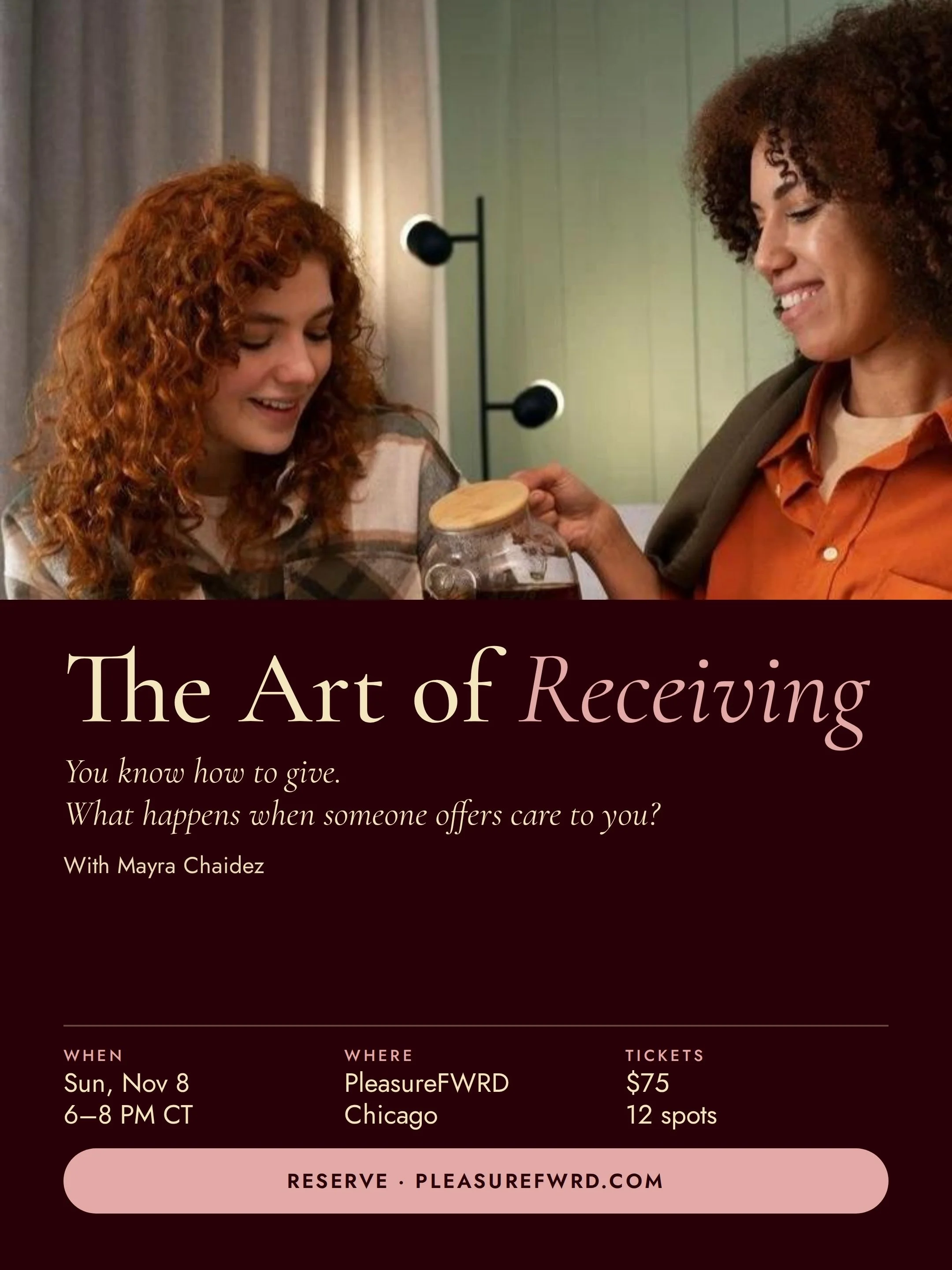
The Art of Receiving℠ | Sunday, November 8, 2026 · 6:00–8:00 PM CT
The Experience
Many of us have learned how to give.
We care for others.
We solve problems.
We anticipate needs.
We work hard.
We remain available.
We know how to offer love, support, attention, appreciation, and care.
But when someone offers something to us—a compliment, help, affection, generosity, rest, or support—we may pull away.
Minimize it.
Apologize.
Immediately give something back.
Question what the other person expects.
Or insist:
“I’m fine.”
The Art of Receiving℠ is a 120-minutes experiential workshop exploring what happens when care, attention, support, appreciation, or generosity moves toward you.
Unlike Letting It Be Good™, which focuses on savoring pleasant moments, The Art of Receiving℠ focuses on the interpersonal experience of allowing something to come from another person without immediately deflecting, earning, repaying, or abandoning your boundaries.
Receiving is not passive.
It involves awareness.
Discernment.
Consent.
Choice.
And the ability to recognize what you genuinely want to welcome.
Because receiving does not mean accepting everything offered to you.
It means becoming more intentional about what you allow yourself to receive.
You’ll Explore
🌿 Understanding Your Receiving Patterns
Explore the beliefs, experiences, family roles, and cultural messages that may influence how you receive.
You may reflect on:
Whether being needed feels safer than needing others
What you learned about accepting help
Whether generosity creates feelings of obligation
How you respond to compliments or appreciation
Whether rest must be earned
What happens when attention is directed toward you
Whether receiving feels vulnerable, selfish, unsafe, or unfamiliar
How quickly you begin planning what to give back
These responses are not treated as failures.
They may reflect important experiences, values, boundaries, or learned ways of protecting yourself.
🧭 Receiving With Discernment
Receiving does not require you to say yes to everything.
You’ll explore the difference between:
Receiving and complying
Receiving and owing
Generosity and manipulation
Appreciation and evaluation
Support and control
Care and unwanted access
Openness and self-abandonment
Mutuality and immediate repayment
You are allowed to receive.
You are also allowed to decline, ask questions, request something different, or change your mind.
🌸 Receiving in the Body
Through gentle somatic awareness, notice how your body responds when receiving attention, kindness, encouragement, support, or appreciation.
You may notice:
Warmth
Tension
Ease
Discomfort
An urge to move away
An urge to minimize
A desire for more
A clear no
Uncertainty
A need for additional time
Body awareness offers information, but no single sensation determines what you should accept. You’ll be encouraged to consider sensation alongside context, consent, trust, values, and conscious choice.
💬 Receiving Appreciation
Practice receiving a simple, specific expression of appreciation without immediately dismissing it or returning a compliment.
You may respond with:
“Thank you.”
“I’m taking that in.”
“I appreciate hearing that.”
“I need a moment to receive that.”
“I’m not available to receive feedback about my appearance.”
“I’d rather receive appreciation about something else.”
You remain in control of what kind of appreciation feels welcome.
🤲 Receiving Support Without Immediate Repayment
Explore what it feels like to accept a small act of support without instantly balancing the exchange.
You may practice:
Allowing someone to assist with a simple task
Naming what kind of support would actually feel helpful
Receiving without apologizing
Saying “that’s enough”
Declining support that does not meet your needs
Allowing mutuality to exist over time rather than in every moment
No participant is required to give or receive anything personal, valuable, or physically intimate.
❤️ Receiving & Relationships
Reflect on the balance between giving and receiving in your relationships.
You may consider:
Where giving feels generous and authentic
Where giving has become automatic or expected
Where you struggle to ask for support
Whether others have room to contribute to you
What makes receiving feel relationally safe enough
What boundaries protect receiving from becoming obligation
✍️ Create Your Receiving Map™
Develop a personal reflection tool identifying:
What you enjoy receiving
What feels difficult or vulnerable to receive
What you do when attention moves toward you
Conditions that help receiving feel consensual and supportive
Forms of receiving you do not want
Language for accepting, modifying, or declining an offer
People and relationships where you want to practice greater mutuality
🌱 Design Your Receiving Practice
Choose one small, realistic practice for everyday life.
Your practice may involve:
Receiving a compliment with “thank you”
Allowing someone to help
Asking clearly for a specific form of support
Accepting rest without apologizing
Pausing before automatically giving back
Naming when an offer does not feel supportive
Allowing yourself to receive enough—and then stop
You May Leave With
Greater awareness of your relationship with receiving
More understanding of the difference between receiving and obligation
Language for accepting, modifying, or declining what is offered
Practices for receiving appreciation and support
Greater permission to allow mutuality in your relationships
Your personalized Receiving Map™
A daily receiving practice grounded in consent and choice
Good to Know
Length
120 Minutes
Designed For
Women and femme-aligned adults, ages 18+
Experience Level
Open to all. No previous somatic or relationship workshop experience is necessary.
What to Bring
Journal
Water bottle
Curiosity
A willingness to practice receiving without forcing yourself
Partner Exercises
Optional partner exercises may include listening, offering verbal appreciation, making a simple request, or practicing how to accept, modify, and decline an offer.
You may participate with a partner, observe, practice independently, or decline.
Touch, Affection & Sexual Activity
This experience does not require physical affection or participant-to-participant touch.
Mayra does not provide massage, tissue manipulation, intimate or erotic touch, genital or breast contact, or hands-on bodywork.
There is no nudity or sexual activity. Any discussion of affection, pleasure, or intimacy remains educational and reflective.
A Note About Emotional Safety
Mayra facilitates through a trauma-informed lens and can hold grounded, compassionate space for emotions that may arise.
Receiving attention or support can bring up vulnerability, grief, suspicion, discomfort, or memories of past obligation. You will never be pressured to receive from another participant, trust someone, share personal history, accept touch, or override a protective response.
Every practice may be modified, observed, paused, or declined.
The Art of Receiving provides relationship education, somatic awareness, communication practice, reflection, and experiential learning. It is not psychotherapy, trauma treatment, medical care, sexual services, or crisis support.
Receiving does not mean accepting everything.
It means remembering that you are allowed to choose what comes closer.
The Experience
Many of us have learned how to give.
We care for others.
We solve problems.
We anticipate needs.
We work hard.
We remain available.
We know how to offer love, support, attention, appreciation, and care.
But when someone offers something to us—a compliment, help, affection, generosity, rest, or support—we may pull away.
Minimize it.
Apologize.
Immediately give something back.
Question what the other person expects.
Or insist:
“I’m fine.”
The Art of Receiving℠ is a 120-minutes experiential workshop exploring what happens when care, attention, support, appreciation, or generosity moves toward you.
Unlike Letting It Be Good™, which focuses on savoring pleasant moments, The Art of Receiving℠ focuses on the interpersonal experience of allowing something to come from another person without immediately deflecting, earning, repaying, or abandoning your boundaries.
Receiving is not passive.
It involves awareness.
Discernment.
Consent.
Choice.
And the ability to recognize what you genuinely want to welcome.
Because receiving does not mean accepting everything offered to you.
It means becoming more intentional about what you allow yourself to receive.
You’ll Explore
🌿 Understanding Your Receiving Patterns
Explore the beliefs, experiences, family roles, and cultural messages that may influence how you receive.
You may reflect on:
Whether being needed feels safer than needing others
What you learned about accepting help
Whether generosity creates feelings of obligation
How you respond to compliments or appreciation
Whether rest must be earned
What happens when attention is directed toward you
Whether receiving feels vulnerable, selfish, unsafe, or unfamiliar
How quickly you begin planning what to give back
These responses are not treated as failures.
They may reflect important experiences, values, boundaries, or learned ways of protecting yourself.
🧭 Receiving With Discernment
Receiving does not require you to say yes to everything.
You’ll explore the difference between:
Receiving and complying
Receiving and owing
Generosity and manipulation
Appreciation and evaluation
Support and control
Care and unwanted access
Openness and self-abandonment
Mutuality and immediate repayment
You are allowed to receive.
You are also allowed to decline, ask questions, request something different, or change your mind.
🌸 Receiving in the Body
Through gentle somatic awareness, notice how your body responds when receiving attention, kindness, encouragement, support, or appreciation.
You may notice:
Warmth
Tension
Ease
Discomfort
An urge to move away
An urge to minimize
A desire for more
A clear no
Uncertainty
A need for additional time
Body awareness offers information, but no single sensation determines what you should accept. You’ll be encouraged to consider sensation alongside context, consent, trust, values, and conscious choice.
💬 Receiving Appreciation
Practice receiving a simple, specific expression of appreciation without immediately dismissing it or returning a compliment.
You may respond with:
“Thank you.”
“I’m taking that in.”
“I appreciate hearing that.”
“I need a moment to receive that.”
“I’m not available to receive feedback about my appearance.”
“I’d rather receive appreciation about something else.”
You remain in control of what kind of appreciation feels welcome.
🤲 Receiving Support Without Immediate Repayment
Explore what it feels like to accept a small act of support without instantly balancing the exchange.
You may practice:
Allowing someone to assist with a simple task
Naming what kind of support would actually feel helpful
Receiving without apologizing
Saying “that’s enough”
Declining support that does not meet your needs
Allowing mutuality to exist over time rather than in every moment
No participant is required to give or receive anything personal, valuable, or physically intimate.
❤️ Receiving & Relationships
Reflect on the balance between giving and receiving in your relationships.
You may consider:
Where giving feels generous and authentic
Where giving has become automatic or expected
Where you struggle to ask for support
Whether others have room to contribute to you
What makes receiving feel relationally safe enough
What boundaries protect receiving from becoming obligation
✍️ Create Your Receiving Map™
Develop a personal reflection tool identifying:
What you enjoy receiving
What feels difficult or vulnerable to receive
What you do when attention moves toward you
Conditions that help receiving feel consensual and supportive
Forms of receiving you do not want
Language for accepting, modifying, or declining an offer
People and relationships where you want to practice greater mutuality
🌱 Design Your Receiving Practice
Choose one small, realistic practice for everyday life.
Your practice may involve:
Receiving a compliment with “thank you”
Allowing someone to help
Asking clearly for a specific form of support
Accepting rest without apologizing
Pausing before automatically giving back
Naming when an offer does not feel supportive
Allowing yourself to receive enough—and then stop
You May Leave With
Greater awareness of your relationship with receiving
More understanding of the difference between receiving and obligation
Language for accepting, modifying, or declining what is offered
Practices for receiving appreciation and support
Greater permission to allow mutuality in your relationships
Your personalized Receiving Map™
A daily receiving practice grounded in consent and choice
Good to Know
Length
120 Minutes
Designed For
Women and femme-aligned adults, ages 18+
Experience Level
Open to all. No previous somatic or relationship workshop experience is necessary.
What to Bring
Journal
Water bottle
Curiosity
A willingness to practice receiving without forcing yourself
Partner Exercises
Optional partner exercises may include listening, offering verbal appreciation, making a simple request, or practicing how to accept, modify, and decline an offer.
You may participate with a partner, observe, practice independently, or decline.
Touch, Affection & Sexual Activity
This experience does not require physical affection or participant-to-participant touch.
Mayra does not provide massage, tissue manipulation, intimate or erotic touch, genital or breast contact, or hands-on bodywork.
There is no nudity or sexual activity. Any discussion of affection, pleasure, or intimacy remains educational and reflective.
A Note About Emotional Safety
Mayra facilitates through a trauma-informed lens and can hold grounded, compassionate space for emotions that may arise.
Receiving attention or support can bring up vulnerability, grief, suspicion, discomfort, or memories of past obligation. You will never be pressured to receive from another participant, trust someone, share personal history, accept touch, or override a protective response.
Every practice may be modified, observed, paused, or declined.
The Art of Receiving provides relationship education, somatic awareness, communication practice, reflection, and experiential learning. It is not psychotherapy, trauma treatment, medical care, sexual services, or crisis support.
Receiving does not mean accepting everything.
It means remembering that you are allowed to choose what comes closer.