 Image 1 of 1
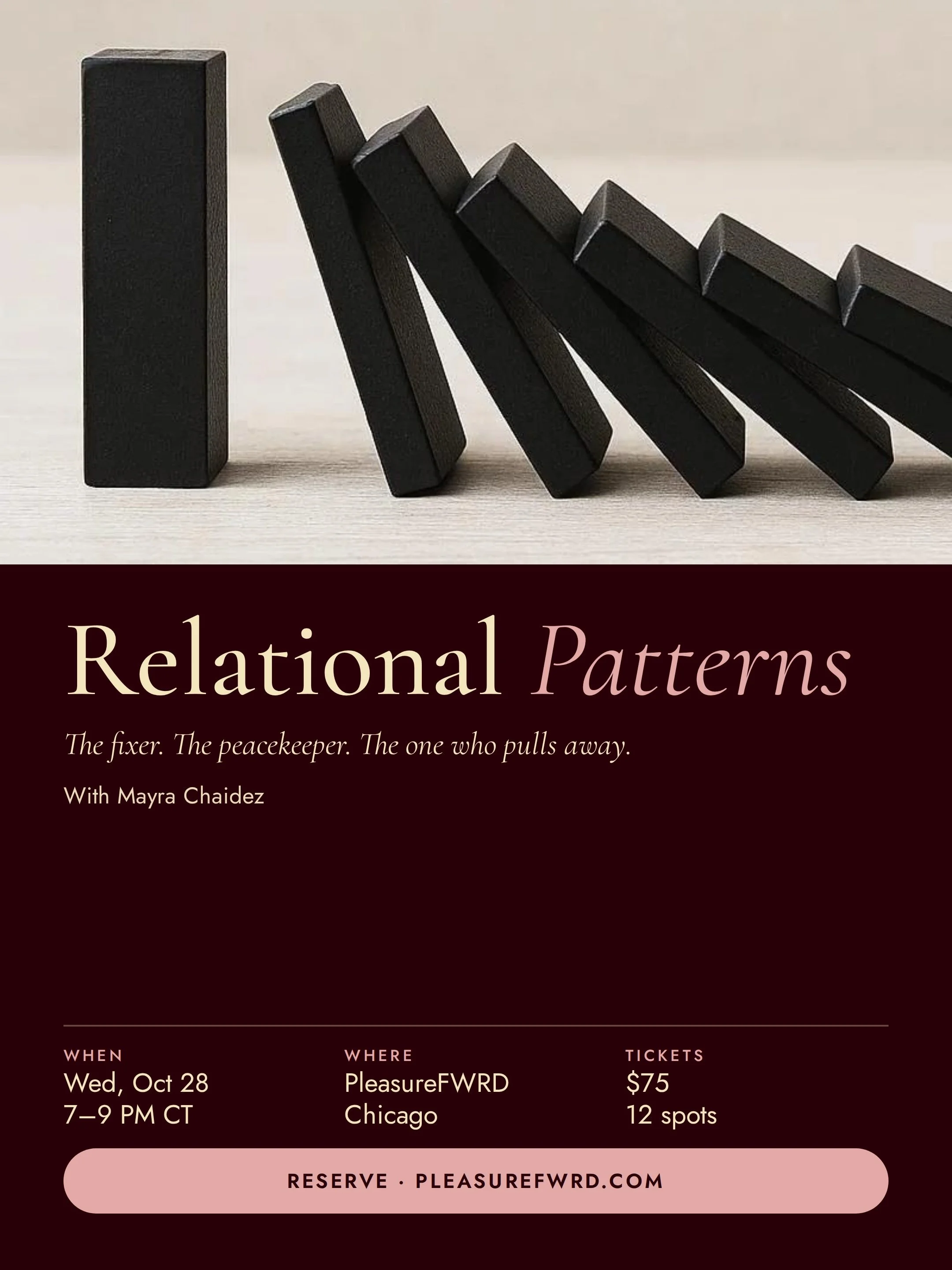
Relational Patterns | Wednesday, October 28, 2026 · 7:00–9:00 PM CT
The Experience
Understanding how you show up in relationships begins with becoming curious about what repeatedly happens between you and other people.
Every relationship tells a story.
Before we can create different ways of connecting, we may need to recognize the roles, expectations, and relational loops we already know.
Relational Patterns™ is an experiential workshop designed to help you explore how past experiences, family and cultural relationship models, learned beliefs, attachment strategies, communication habits, and protective roles may influence the way you connect with others today.
Rather than focusing on blame, labels, or fixing yourself, this experience invites curiosity.
Together, we’ll explore why certain interactions feel easy while others repeatedly leave us feeling misunderstood, disconnected, overextended, resentful, or emotionally distant.
You may recognize that you tend to pursue.
Withdraw.
Please.
Fix.
Control.
Avoid.
Overfunction.
Or abandon your own needs to preserve connection.
Through evidence-informed relationship education, guided reflection, experiential exercises, and meaningful conversation, you’ll begin identifying the patterns that shape your relationships—and consider whether those patterns still support the connection you want to create.
This experience asks:
What repeatedly happens between me and other people?
And where might a different choice become possible?
You’ll Experience
🌿 Where Our Patterns Begin
Reflect on the messages, expectations, and relationship models that may have shaped how you understand closeness, independence, love, conflict, boundaries, and belonging.
You may explore:
What you learned relationships were supposed to look like
The role you were expected to play in your family
What happened when you expressed needs or disagreement
Whether closeness felt consistent, conditional, overwhelming, or unavailable
How cultural, religious, or gender expectations influenced you
Which patterns you want to continue—and which no longer feel aligned
You are always in control of what you explore and share.
🧠 Attachment & Relational Strategies
Receive an accessible introduction to attachment concepts and common strategies people may use to preserve connection or protect themselves from disappointment.
These ideas are offered as frameworks for reflection—not diagnoses, fixed identities, or definitive explanations of anyone’s behavior.
The goal is not to label yourself or another person.
It is to become more curious about the strategies you learned and what they may be trying to accomplish.
🎭 The Roles We Learn to Play
Explore the roles you may automatically assume in relationships, such as:
The pursuer
The withdrawer
The pleaser
The fixer
The peacekeeper
The caretaker
The overfunctioner
The one who never needs anything
The one who leaves before being left
These roles are not character flaws.
They may be learned attempts to create safety, maintain connection, avoid conflict, or feel needed.
You’ll be invited to notice when a role feels authentic—and when it requires you to abandon yourself.
🔄 Recognizing Your Relational Loop
Explore what tends to happen before, during, and after a familiar relationship pattern.
You may notice:
The situation that begins the pattern
The meaning or assumption you quickly make
The role you automatically step into
What you do next—pursue, withdraw, please, fix, control, avoid, or shut down
How the other person may respond
How the pattern reinforces itself
What you wish you could communicate or choose differently
Body awareness may help you recognize when a familiar loop is beginning, but the focus of this experience is the relationship pattern itself—how it unfolds between people and where greater choice may become possible.
You will not be asked to recreate a conflict, diagnose another person, or intentionally activate yourself.
💬 Needs, Boundaries & Communication
Consider what may be difficult to say once a relational pattern begins.
What do you need?
What boundary may be missing?
What are you afraid might happen if you communicate honestly?
You’ll practice translating automatic reactions into clearer language for wants, needs, boundaries, and requests.
✍️ Guided Reflection & Journaling
Use thoughtful prompts to explore which patterns feel supportive, which may feel limiting, and what you want to practice differently.
🗺️ Create Your Relational Patterns Map™
Develop a personal awareness tool identifying:
Patterns you recognize in yourself
Situations that make those patterns more likely to appear
The role you tend to assume
The story or expectation beneath the pattern
Needs or boundaries that may be difficult to express
How the pattern affects connection
A different response you may want to practice
Questions you want to continue exploring
Your map is not a psychological assessment or treatment plan.
It is a living reflection you can continue developing over time.
🌙 Integration
Close by choosing one small relational practice to explore in everyday life.
This may be naming a need earlier, pausing before assuming, asking a curious question, allowing someone else to help, or honoring a boundary without overexplaining.
Sharing is always optional.
You’ll Carry Forward
Greater awareness of your relational patterns
An accessible understanding of attachment concepts
More compassionate language for understanding learned relationship roles
Greater clarity about the loops that repeatedly appear between you and others
Tools for identifying needs, boundaries, and communication choices
Your personalized Relational Patterns Map™
One practical relational shift to explore in everyday life
Perfect For
Women who want to better understand themselves in romantic, familial, platonic, professional, or community relationships.
You do not need to attend with a partner or currently be in a romantic relationship.
This experience focuses on your patterns and choices—not analyzing, diagnosing, or changing another person.
Good to Know
Designed For
Women and femme-aligned adults, ages 18+
Experience Level
Open to all. No previous knowledge of attachment, somatic practices, or relationship psychology is necessary.
What to Bring
Journal
Water bottle
Curiosity
A willingness to reflect without judging yourself
Touch
Mayra does not provide massage, tissue manipulation, or intimate or erotic touch. This experience does not require participant-to-participant touch.
A Note About Emotional Safety
Mayra facilitates through a trauma-informed lens and can hold grounded, compassionate space for emotions that may arise.
You will never be required to disclose trauma, identify another person, share private relationship details, or revisit an experience before you are ready. Every reflection and practice may be modified, paused, or declined.
Relational Patterns provides relationship education, guided reflection, somatic awareness, and experiential learning. It is not psychotherapy, trauma treatment, couples therapy, psychological assessment, attachment diagnosis, mediation, or crisis support.
Your patterns are not proof that something is wrong with you.
They are invitations to understand how you learned to connect—and to choose what you want to practice now.
The Experience
Understanding how you show up in relationships begins with becoming curious about what repeatedly happens between you and other people.
Every relationship tells a story.
Before we can create different ways of connecting, we may need to recognize the roles, expectations, and relational loops we already know.
Relational Patterns™ is an experiential workshop designed to help you explore how past experiences, family and cultural relationship models, learned beliefs, attachment strategies, communication habits, and protective roles may influence the way you connect with others today.
Rather than focusing on blame, labels, or fixing yourself, this experience invites curiosity.
Together, we’ll explore why certain interactions feel easy while others repeatedly leave us feeling misunderstood, disconnected, overextended, resentful, or emotionally distant.
You may recognize that you tend to pursue.
Withdraw.
Please.
Fix.
Control.
Avoid.
Overfunction.
Or abandon your own needs to preserve connection.
Through evidence-informed relationship education, guided reflection, experiential exercises, and meaningful conversation, you’ll begin identifying the patterns that shape your relationships—and consider whether those patterns still support the connection you want to create.
This experience asks:
What repeatedly happens between me and other people?
And where might a different choice become possible?
You’ll Experience
🌿 Where Our Patterns Begin
Reflect on the messages, expectations, and relationship models that may have shaped how you understand closeness, independence, love, conflict, boundaries, and belonging.
You may explore:
What you learned relationships were supposed to look like
The role you were expected to play in your family
What happened when you expressed needs or disagreement
Whether closeness felt consistent, conditional, overwhelming, or unavailable
How cultural, religious, or gender expectations influenced you
Which patterns you want to continue—and which no longer feel aligned
You are always in control of what you explore and share.
🧠 Attachment & Relational Strategies
Receive an accessible introduction to attachment concepts and common strategies people may use to preserve connection or protect themselves from disappointment.
These ideas are offered as frameworks for reflection—not diagnoses, fixed identities, or definitive explanations of anyone’s behavior.
The goal is not to label yourself or another person.
It is to become more curious about the strategies you learned and what they may be trying to accomplish.
🎭 The Roles We Learn to Play
Explore the roles you may automatically assume in relationships, such as:
The pursuer
The withdrawer
The pleaser
The fixer
The peacekeeper
The caretaker
The overfunctioner
The one who never needs anything
The one who leaves before being left
These roles are not character flaws.
They may be learned attempts to create safety, maintain connection, avoid conflict, or feel needed.
You’ll be invited to notice when a role feels authentic—and when it requires you to abandon yourself.
🔄 Recognizing Your Relational Loop
Explore what tends to happen before, during, and after a familiar relationship pattern.
You may notice:
The situation that begins the pattern
The meaning or assumption you quickly make
The role you automatically step into
What you do next—pursue, withdraw, please, fix, control, avoid, or shut down
How the other person may respond
How the pattern reinforces itself
What you wish you could communicate or choose differently
Body awareness may help you recognize when a familiar loop is beginning, but the focus of this experience is the relationship pattern itself—how it unfolds between people and where greater choice may become possible.
You will not be asked to recreate a conflict, diagnose another person, or intentionally activate yourself.
💬 Needs, Boundaries & Communication
Consider what may be difficult to say once a relational pattern begins.
What do you need?
What boundary may be missing?
What are you afraid might happen if you communicate honestly?
You’ll practice translating automatic reactions into clearer language for wants, needs, boundaries, and requests.
✍️ Guided Reflection & Journaling
Use thoughtful prompts to explore which patterns feel supportive, which may feel limiting, and what you want to practice differently.
🗺️ Create Your Relational Patterns Map™
Develop a personal awareness tool identifying:
Patterns you recognize in yourself
Situations that make those patterns more likely to appear
The role you tend to assume
The story or expectation beneath the pattern
Needs or boundaries that may be difficult to express
How the pattern affects connection
A different response you may want to practice
Questions you want to continue exploring
Your map is not a psychological assessment or treatment plan.
It is a living reflection you can continue developing over time.
🌙 Integration
Close by choosing one small relational practice to explore in everyday life.
This may be naming a need earlier, pausing before assuming, asking a curious question, allowing someone else to help, or honoring a boundary without overexplaining.
Sharing is always optional.
You’ll Carry Forward
Greater awareness of your relational patterns
An accessible understanding of attachment concepts
More compassionate language for understanding learned relationship roles
Greater clarity about the loops that repeatedly appear between you and others
Tools for identifying needs, boundaries, and communication choices
Your personalized Relational Patterns Map™
One practical relational shift to explore in everyday life
Perfect For
Women who want to better understand themselves in romantic, familial, platonic, professional, or community relationships.
You do not need to attend with a partner or currently be in a romantic relationship.
This experience focuses on your patterns and choices—not analyzing, diagnosing, or changing another person.
Good to Know
Designed For
Women and femme-aligned adults, ages 18+
Experience Level
Open to all. No previous knowledge of attachment, somatic practices, or relationship psychology is necessary.
What to Bring
Journal
Water bottle
Curiosity
A willingness to reflect without judging yourself
Touch
Mayra does not provide massage, tissue manipulation, or intimate or erotic touch. This experience does not require participant-to-participant touch.
A Note About Emotional Safety
Mayra facilitates through a trauma-informed lens and can hold grounded, compassionate space for emotions that may arise.
You will never be required to disclose trauma, identify another person, share private relationship details, or revisit an experience before you are ready. Every reflection and practice may be modified, paused, or declined.
Relational Patterns provides relationship education, guided reflection, somatic awareness, and experiential learning. It is not psychotherapy, trauma treatment, couples therapy, psychological assessment, attachment diagnosis, mediation, or crisis support.
Your patterns are not proof that something is wrong with you.
They are invitations to understand how you learned to connect—and to choose what you want to practice now.