 Image 1 of 1
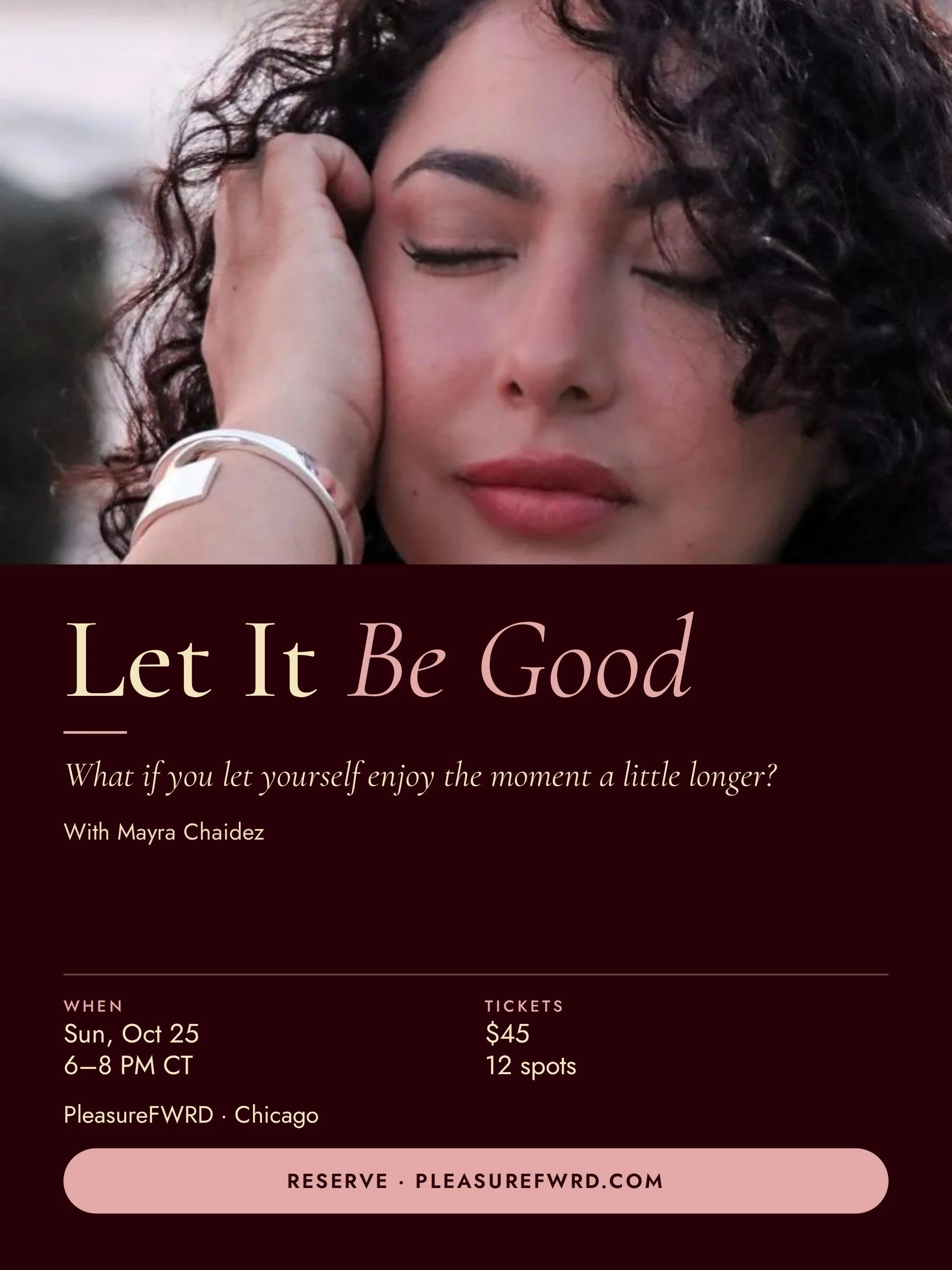
Let It Be Good | Sunday, October 25, 2026 · 6:00–8:00 PM CT
The Experience
Have you ever noticed how quickly you move past the good moments?
You finish a project and immediately think about what comes next.
Someone gives you a compliment and you brush it off.
You finally have time to rest—but instead of enjoying it, you feel guilty.
Something beautiful happens, yet part of you is already preparing for it to end.
For many women, the challenge is not always that pleasure, joy, or connection are unavailable.
It is that staying present long enough to receive them can feel unfamiliar.
Letting It Be Good™ is an experiential workshop exploring our ability to notice, receive, and savor pleasant moments without immediately minimizing them, performing gratitude, searching for what is wrong, or feeling as though we must earn them.
Through evidence-informed education, somatic awareness, sensory exploration, guided reflection, and meaningful connection, you’ll become curious about the patterns that interrupt enjoyment and practice remaining present with goodness for a few moments longer.
This experience is not about forcing happiness.
It is not about ignoring grief, stress, anger, fear, or the realities of your life.
It is about allowing a genuinely good moment to be good while it is here.
Because sometimes receiving begins with not rushing away.
You’ll Experience
🌿 Noticing What Interrupts the Good
Reflect on what tends to happen when something feels pleasurable, affirming, peaceful, or meaningful.
You may notice patterns such as:
Minimizing the experience
Distracting yourself
Moving immediately to the next task
Feeling guilty
Questioning whether you deserve it
Searching for what could go wrong
Deflecting compliments
Turning receiving into another performance
Feeling responsible for making the moment last
Becoming uncomfortable when attention is directed toward you
These patterns are not treated as failures.
They are invitations to understand what receiving feels like for you.
🧠 The Practice of Savoring
Learn about savoring as the intentional practice of giving attention to a pleasant or meaningful experience.
Savoring does not require exaggerating a moment or convincing yourself to feel differently.
It may be as simple as noticing:
This feels warm.
I like this.
I feel connected.
I want to stay here for another breath.
That mattered to me.
🌸 Somatic Receiving Practice
Explore short, self-directed practices for noticing pleasant or supportive sensations.
You may work with:
Warmth
Texture
Sound
Color
Breath
Movement
Comfort
Appreciation
A supportive object
A meaningful memory
A moment of connection
You decide what feels pleasant enough to explore.
Pleasure is never assumed, and you may stop whenever you have received enough.
💬 Receiving Without Deflecting
Practice receiving something simple—such as appreciation, kind attention, or a compliment—without immediately dismissing it, explaining it away, or returning it.
A response may be as simple as:
“Thank you.”
“I’m letting that land.”
“I appreciate hearing that.”
“I need a moment to receive that.”
Interactive exercises are optional, nonsexual, and do not require physical touch.
✨ Staying for One More Moment
Experiment with remaining present with something good for one additional breath, sensation, or moment.
The goal is not to hold onto pleasure permanently.
It is to notice what happens when you do not rush away quite as quickly.
✍️ Reflection & Journaling
Explore your relationship with receiving, guilt, productivity, worthiness, and positive attention.
You may consider:
What kinds of goodness are easiest for me to receive?
What kinds feel more vulnerable?
What do I do when someone appreciates me?
What makes rest or enjoyment feel undeserved?
How do I know when I have received enough?
What would it mean to let one moment be complete?
🌱 Create Your Savoring Practice™
Design one small, realistic practice for noticing and receiving meaningful moments in everyday life.
Your practice might involve:
Pausing after completing something
Receiving a compliment with “thank you”
Taking three breaths with a pleasant sensation
Photographing an ordinary moment you want to remember
Writing down one experience that felt meaningful
Allowing rest without making it productive
Letting a celebration end without immediately planning the next achievement
This is not a gratitude requirement.
It is an invitation to notice what is genuinely good for you.
You May Leave With
Greater awareness of what interrupts enjoyment or receiving
A clearer understanding of your relationship with positive attention
Practical savoring and sensory-awareness exercises
Language for receiving appreciation without immediately deflecting
Greater permission to experience goodness alongside life’s complexity
Your personal Savoring Practice™
An invitation to stay with meaningful moments a little longer
Perfect For
Women who struggle to slow down, feel guilty while resting, move immediately from one achievement to the next, deflect compliments, or want to become more present with joy, beauty, connection, and appreciation in everyday life.
Good to Know
Designed For
Women and femme-aligned adults, ages 18+
Experience Level
Open to all. No previous somatic or mindfulness experience is necessary.
What to Bring
Journal
Water bottle
Curiosity
A willingness to receive without forcing yourself
Partner Exercises
Optional partner exercises may involve conversation, listening, or offering and receiving simple appreciation.
There is no required participant-to-participant physical touch. You may observe, practice alone, or decline any exercise.
Touch & Sexual Activity
Mayra does not provide massage, tissue manipulation, or intimate or erotic touch.
There is no nudity, sexual activity, genital or breast contact, or required physical touch.
A Note About Emotional Safety
Mayra facilitates through a trauma-informed lens and can hold grounded, compassionate space for emotions that may arise.
Pleasant experiences and receiving attention can sometimes bring up discomfort, grief, vulnerability, or mixed emotions. You will never be pressured to feel grateful, happy, relaxed, or positive.
You may pause, modify, observe, step outside, or stop participating without explanation.
Letting It Be Good provides education, somatic awareness, sensory exploration, reflection, and experiential learning. It is not psychotherapy, trauma treatment, medical care, or crisis support.
You do not have to make the moment last forever.
You only have to let it be here while it is here.
The Experience
Have you ever noticed how quickly you move past the good moments?
You finish a project and immediately think about what comes next.
Someone gives you a compliment and you brush it off.
You finally have time to rest—but instead of enjoying it, you feel guilty.
Something beautiful happens, yet part of you is already preparing for it to end.
For many women, the challenge is not always that pleasure, joy, or connection are unavailable.
It is that staying present long enough to receive them can feel unfamiliar.
Letting It Be Good™ is an experiential workshop exploring our ability to notice, receive, and savor pleasant moments without immediately minimizing them, performing gratitude, searching for what is wrong, or feeling as though we must earn them.
Through evidence-informed education, somatic awareness, sensory exploration, guided reflection, and meaningful connection, you’ll become curious about the patterns that interrupt enjoyment and practice remaining present with goodness for a few moments longer.
This experience is not about forcing happiness.
It is not about ignoring grief, stress, anger, fear, or the realities of your life.
It is about allowing a genuinely good moment to be good while it is here.
Because sometimes receiving begins with not rushing away.
You’ll Experience
🌿 Noticing What Interrupts the Good
Reflect on what tends to happen when something feels pleasurable, affirming, peaceful, or meaningful.
You may notice patterns such as:
Minimizing the experience
Distracting yourself
Moving immediately to the next task
Feeling guilty
Questioning whether you deserve it
Searching for what could go wrong
Deflecting compliments
Turning receiving into another performance
Feeling responsible for making the moment last
Becoming uncomfortable when attention is directed toward you
These patterns are not treated as failures.
They are invitations to understand what receiving feels like for you.
🧠 The Practice of Savoring
Learn about savoring as the intentional practice of giving attention to a pleasant or meaningful experience.
Savoring does not require exaggerating a moment or convincing yourself to feel differently.
It may be as simple as noticing:
This feels warm.
I like this.
I feel connected.
I want to stay here for another breath.
That mattered to me.
🌸 Somatic Receiving Practice
Explore short, self-directed practices for noticing pleasant or supportive sensations.
You may work with:
Warmth
Texture
Sound
Color
Breath
Movement
Comfort
Appreciation
A supportive object
A meaningful memory
A moment of connection
You decide what feels pleasant enough to explore.
Pleasure is never assumed, and you may stop whenever you have received enough.
💬 Receiving Without Deflecting
Practice receiving something simple—such as appreciation, kind attention, or a compliment—without immediately dismissing it, explaining it away, or returning it.
A response may be as simple as:
“Thank you.”
“I’m letting that land.”
“I appreciate hearing that.”
“I need a moment to receive that.”
Interactive exercises are optional, nonsexual, and do not require physical touch.
✨ Staying for One More Moment
Experiment with remaining present with something good for one additional breath, sensation, or moment.
The goal is not to hold onto pleasure permanently.
It is to notice what happens when you do not rush away quite as quickly.
✍️ Reflection & Journaling
Explore your relationship with receiving, guilt, productivity, worthiness, and positive attention.
You may consider:
What kinds of goodness are easiest for me to receive?
What kinds feel more vulnerable?
What do I do when someone appreciates me?
What makes rest or enjoyment feel undeserved?
How do I know when I have received enough?
What would it mean to let one moment be complete?
🌱 Create Your Savoring Practice™
Design one small, realistic practice for noticing and receiving meaningful moments in everyday life.
Your practice might involve:
Pausing after completing something
Receiving a compliment with “thank you”
Taking three breaths with a pleasant sensation
Photographing an ordinary moment you want to remember
Writing down one experience that felt meaningful
Allowing rest without making it productive
Letting a celebration end without immediately planning the next achievement
This is not a gratitude requirement.
It is an invitation to notice what is genuinely good for you.
You May Leave With
Greater awareness of what interrupts enjoyment or receiving
A clearer understanding of your relationship with positive attention
Practical savoring and sensory-awareness exercises
Language for receiving appreciation without immediately deflecting
Greater permission to experience goodness alongside life’s complexity
Your personal Savoring Practice™
An invitation to stay with meaningful moments a little longer
Perfect For
Women who struggle to slow down, feel guilty while resting, move immediately from one achievement to the next, deflect compliments, or want to become more present with joy, beauty, connection, and appreciation in everyday life.
Good to Know
Designed For
Women and femme-aligned adults, ages 18+
Experience Level
Open to all. No previous somatic or mindfulness experience is necessary.
What to Bring
Journal
Water bottle
Curiosity
A willingness to receive without forcing yourself
Partner Exercises
Optional partner exercises may involve conversation, listening, or offering and receiving simple appreciation.
There is no required participant-to-participant physical touch. You may observe, practice alone, or decline any exercise.
Touch & Sexual Activity
Mayra does not provide massage, tissue manipulation, or intimate or erotic touch.
There is no nudity, sexual activity, genital or breast contact, or required physical touch.
A Note About Emotional Safety
Mayra facilitates through a trauma-informed lens and can hold grounded, compassionate space for emotions that may arise.
Pleasant experiences and receiving attention can sometimes bring up discomfort, grief, vulnerability, or mixed emotions. You will never be pressured to feel grateful, happy, relaxed, or positive.
You may pause, modify, observe, step outside, or stop participating without explanation.
Letting It Be Good provides education, somatic awareness, sensory exploration, reflection, and experiential learning. It is not psychotherapy, trauma treatment, medical care, or crisis support.
You do not have to make the moment last forever.
You only have to let it be here while it is here.