 Image 1 of 1
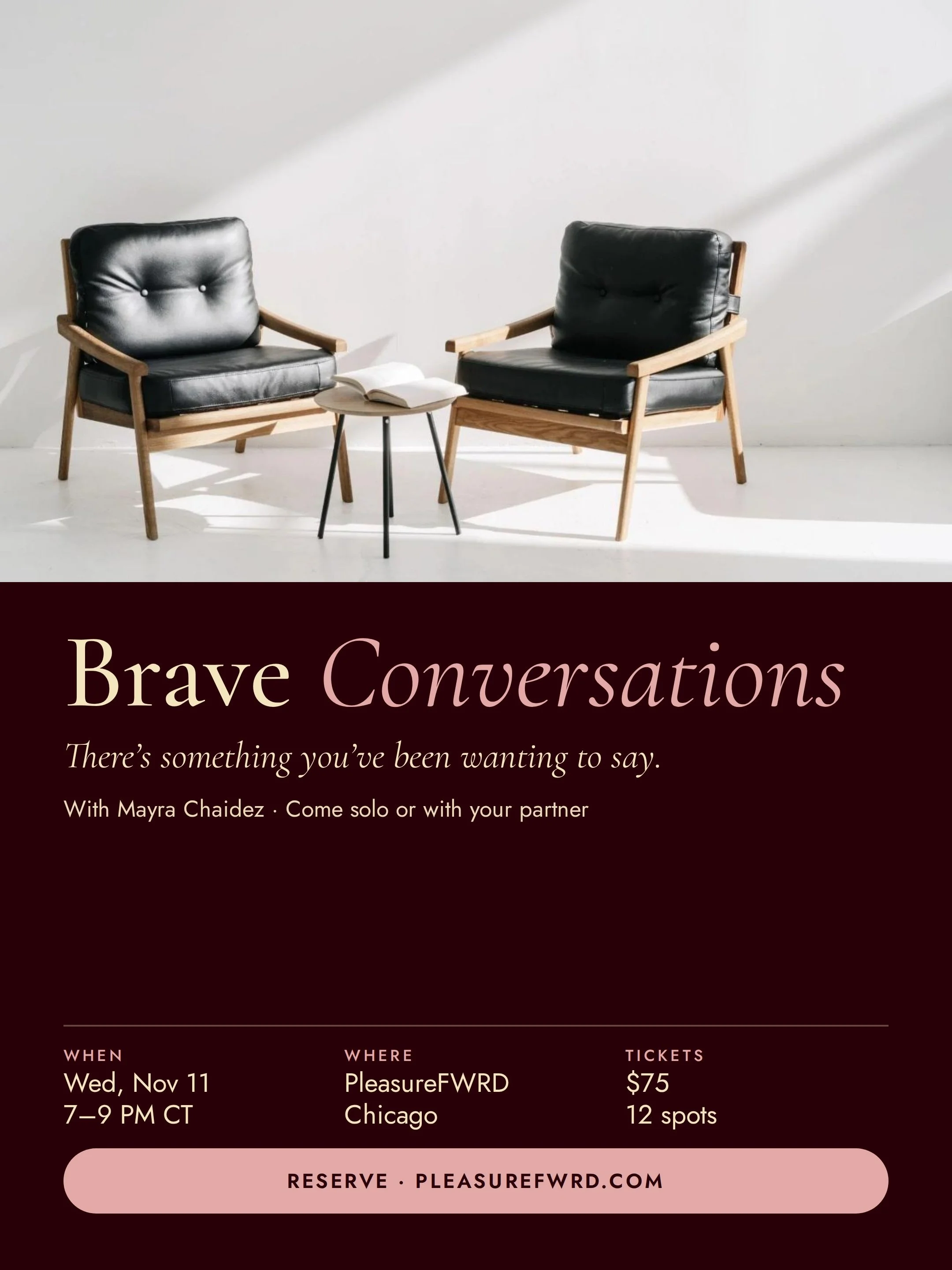
Brave Conversations | Wednesday, November 11, 2026 · 7:00–9:00 PM CT
The Experience
Some conversations feel difficult before they even begin.
Naming what you want. Asking for something different. Expressing a boundary. Sharing a desire. Acknowledging that something has changed. Saying what has remained unspoken because you are afraid of disappointing someone, being misunderstood, or disrupting the relationship.
Brave Conversations™ is an interactive relationship workshop designed to help you prepare for honest, vulnerable conversations without abandoning yourself or trying to control the other person’s response.
Unlike Conflict Without Disconnection™, which focuses on navigating disagreement once conflict is happening, this experience focuses on finding the courage, clarity, and language to begin an important conversation.
Bravery does not mean saying everything immediately.
Sometimes bravery is speaking.
Sometimes it is asking a question.
Sometimes it is waiting until you have the clarity, support, and conditions you need.
You’ll Experience
🌿 Arriving & Grounding
Begin with gentle breath awareness and a present-moment check-in.
You will be invited to notice what happens in your body when you imagine speaking honestly—without forcing yourself to disclose the conversation you are considering.
💭 What Makes a Conversation Feel Brave?
Explore the fears, expectations, and possible consequences that can make certain subjects difficult to approach.
You may notice concerns about rejection, disappointing someone, being perceived as demanding, creating tension, or discovering that another person wants something different.
The goal is not to eliminate fear. It is to understand what the fear may be protecting and determine what support you need.
🧭 Clarifying What You Want to Communicate
Separate what you know from what you assume, what you feel from what you fear, and what you need from what you hope the other person will do.
You will identify the central truth, question, request, or boundary you want to communicate without overexplaining or building an argument in advance.
🗣️ Finding Your Words
Practice language for beginning conversations about relationships, boundaries, intimacy, desire, sex, changing needs, expectations, repair, or other meaningful subjects.
You may experiment with phrases such as:
“There is something important I would like to share.”
“I care about our relationship, and I want to be honest about what I am noticing.”
“I do not need an immediate answer, but I would like us to talk about this.”
“Would now be an okay time for a vulnerable conversation?”
“I would like to understand your experience, too.”
👂 Making Room for a Response
Explore how to communicate honestly without scripting the other person’s reaction.
You will practice staying connected to yourself while making room for questions, uncertainty, disappointment, difference, or the need for time.
Honesty creates an opportunity for connection, but it does not guarantee agreement.
🛑 Discernment, Boundaries & Timing
Consider whether the conversation is emotionally and physically safe to have, what setting would be most appropriate, and what boundaries may be needed.
You will identify when to continue, pause, seek additional support, or decide that direct conversation may not be safe.
🎭 Optional Conversation Practice
Use fictional scenarios or a personally chosen low-stakes topic to rehearse an opening statement, boundary, request, or question.
You may practice independently, with an established partner who attends with you, or with another participant using a fictional prompt.
No one is required to disclose private details or rehearse an active relationship crisis.
✍️ Your Brave Conversation Plan
Close by creating a personal preparation plan that may include:
What you want to communicate
Why the conversation matters
What you are asking for
What remains negotiable
What is a boundary
When and where you want to speak
What support you may need before or afterward
You May Leave With
Greater clarity about what you want to communicate
Language for beginning a vulnerable conversation
A clearer distinction between a desire, request, expectation, and boundary
Greater awareness of timing, setting, and emotional safety
Practice expressing yourself without overexplaining
A personalized Brave Conversation Plan
More confidence honoring both honesty and choice
Good to Know
Designed For
Women and femme-aligned adults, ages 18+
You may attend independently or with an established partner. Partners of any gender are welcome when attending together and aligned with the agreements and purpose of the space.
Experience Level
Open to all. No previous experience with communication workshops or relationship coaching is necessary.
Participation
All sharing and practice are optional. You may use fictional scenarios, write privately, observe an exercise, or decline any invitation.
You will not be required to reveal relationship details, discuss trauma, disclose your sexuality, or conduct a real conversation during the workshop.
Touch
This experience does not include facilitator touch, participant-to-participant touch, massage, intimate or erotic contact, nudity, or sexual activity.
Practices are conversational, reflective, and fully clothed.
A Note About Emotional & Relational Safety
Mayra facilitates through a trauma-informed lens and can hold grounded, compassionate space for emotions that may arise. Every practice may be modified, paused, observed, or declined.
Brave Conversations™ is an educational relationship-skills and self-exploration experience. It is not psychotherapy, couples therapy, mediation, trauma treatment, legal advice, domestic-violence intervention, or crisis support.
This workshop does not encourage direct confrontation when speaking honestly could lead to intimidation, coercion, retaliation, stalking, financial control, or violence. In those circumstances, individualized safety planning with a qualified professional may be more appropriate than initiating a conversation.
You do not need perfect words.
You need enough clarity to begin—and enough self-trust to listen to what happens next.
The Experience
Some conversations feel difficult before they even begin.
Naming what you want. Asking for something different. Expressing a boundary. Sharing a desire. Acknowledging that something has changed. Saying what has remained unspoken because you are afraid of disappointing someone, being misunderstood, or disrupting the relationship.
Brave Conversations™ is an interactive relationship workshop designed to help you prepare for honest, vulnerable conversations without abandoning yourself or trying to control the other person’s response.
Unlike Conflict Without Disconnection™, which focuses on navigating disagreement once conflict is happening, this experience focuses on finding the courage, clarity, and language to begin an important conversation.
Bravery does not mean saying everything immediately.
Sometimes bravery is speaking.
Sometimes it is asking a question.
Sometimes it is waiting until you have the clarity, support, and conditions you need.
You’ll Experience
🌿 Arriving & Grounding
Begin with gentle breath awareness and a present-moment check-in.
You will be invited to notice what happens in your body when you imagine speaking honestly—without forcing yourself to disclose the conversation you are considering.
💭 What Makes a Conversation Feel Brave?
Explore the fears, expectations, and possible consequences that can make certain subjects difficult to approach.
You may notice concerns about rejection, disappointing someone, being perceived as demanding, creating tension, or discovering that another person wants something different.
The goal is not to eliminate fear. It is to understand what the fear may be protecting and determine what support you need.
🧭 Clarifying What You Want to Communicate
Separate what you know from what you assume, what you feel from what you fear, and what you need from what you hope the other person will do.
You will identify the central truth, question, request, or boundary you want to communicate without overexplaining or building an argument in advance.
🗣️ Finding Your Words
Practice language for beginning conversations about relationships, boundaries, intimacy, desire, sex, changing needs, expectations, repair, or other meaningful subjects.
You may experiment with phrases such as:
“There is something important I would like to share.”
“I care about our relationship, and I want to be honest about what I am noticing.”
“I do not need an immediate answer, but I would like us to talk about this.”
“Would now be an okay time for a vulnerable conversation?”
“I would like to understand your experience, too.”
👂 Making Room for a Response
Explore how to communicate honestly without scripting the other person’s reaction.
You will practice staying connected to yourself while making room for questions, uncertainty, disappointment, difference, or the need for time.
Honesty creates an opportunity for connection, but it does not guarantee agreement.
🛑 Discernment, Boundaries & Timing
Consider whether the conversation is emotionally and physically safe to have, what setting would be most appropriate, and what boundaries may be needed.
You will identify when to continue, pause, seek additional support, or decide that direct conversation may not be safe.
🎭 Optional Conversation Practice
Use fictional scenarios or a personally chosen low-stakes topic to rehearse an opening statement, boundary, request, or question.
You may practice independently, with an established partner who attends with you, or with another participant using a fictional prompt.
No one is required to disclose private details or rehearse an active relationship crisis.
✍️ Your Brave Conversation Plan
Close by creating a personal preparation plan that may include:
What you want to communicate
Why the conversation matters
What you are asking for
What remains negotiable
What is a boundary
When and where you want to speak
What support you may need before or afterward
You May Leave With
Greater clarity about what you want to communicate
Language for beginning a vulnerable conversation
A clearer distinction between a desire, request, expectation, and boundary
Greater awareness of timing, setting, and emotional safety
Practice expressing yourself without overexplaining
A personalized Brave Conversation Plan
More confidence honoring both honesty and choice
Good to Know
Designed For
Women and femme-aligned adults, ages 18+
You may attend independently or with an established partner. Partners of any gender are welcome when attending together and aligned with the agreements and purpose of the space.
Experience Level
Open to all. No previous experience with communication workshops or relationship coaching is necessary.
Participation
All sharing and practice are optional. You may use fictional scenarios, write privately, observe an exercise, or decline any invitation.
You will not be required to reveal relationship details, discuss trauma, disclose your sexuality, or conduct a real conversation during the workshop.
Touch
This experience does not include facilitator touch, participant-to-participant touch, massage, intimate or erotic contact, nudity, or sexual activity.
Practices are conversational, reflective, and fully clothed.
A Note About Emotional & Relational Safety
Mayra facilitates through a trauma-informed lens and can hold grounded, compassionate space for emotions that may arise. Every practice may be modified, paused, observed, or declined.
Brave Conversations™ is an educational relationship-skills and self-exploration experience. It is not psychotherapy, couples therapy, mediation, trauma treatment, legal advice, domestic-violence intervention, or crisis support.
This workshop does not encourage direct confrontation when speaking honestly could lead to intimidation, coercion, retaliation, stalking, financial control, or violence. In those circumstances, individualized safety planning with a qualified professional may be more appropriate than initiating a conversation.
You do not need perfect words.
You need enough clarity to begin—and enough self-trust to listen to what happens next.