 Image 1 of 1
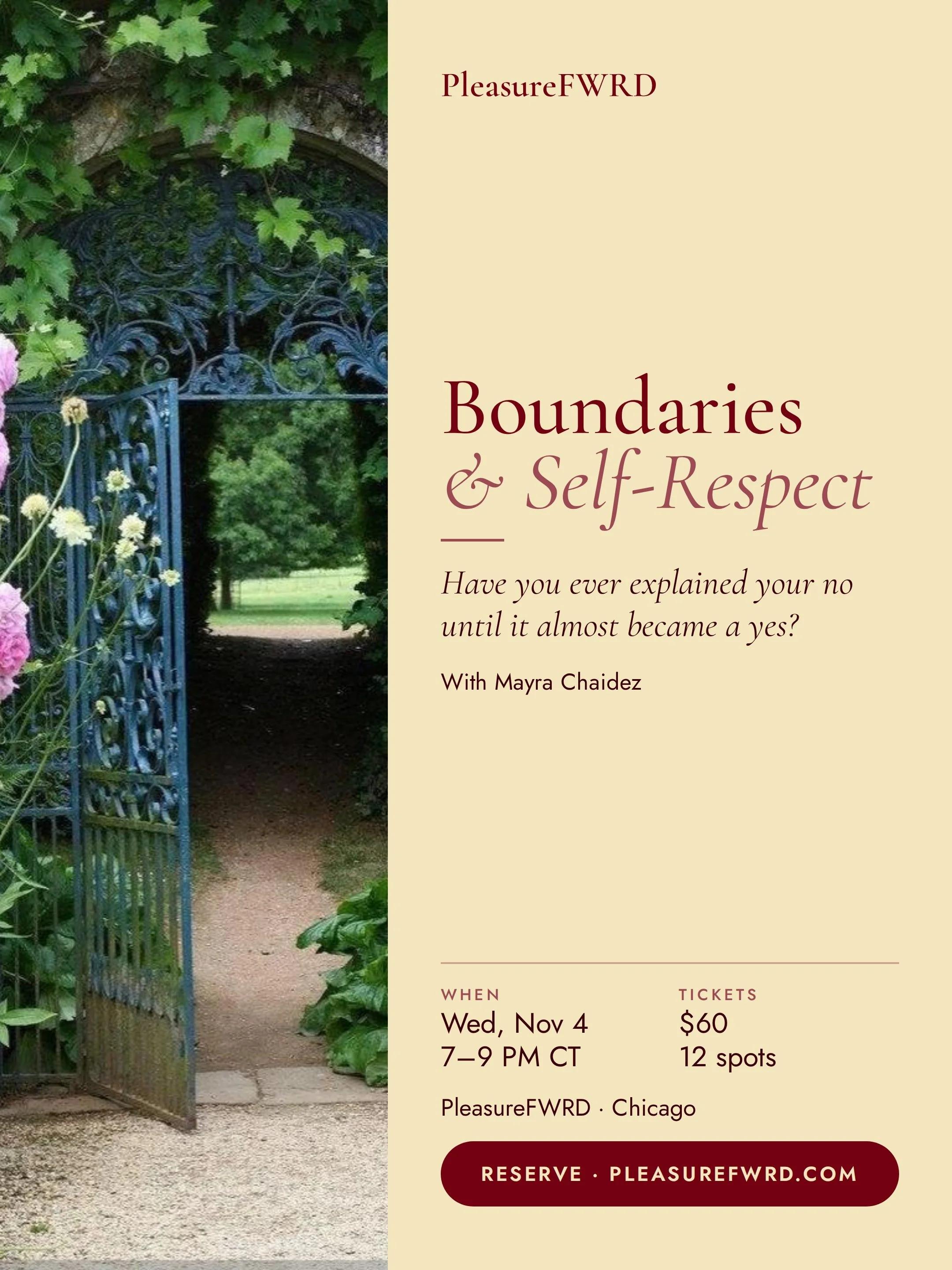
Boundaries & Self-Respect | Wednesday, November 4, 2026 · 7:00–9:00 PM CT
The Experience
Healthy boundaries aren’t walls.
They are one of the clearest expressions of self-awareness and self-respect.
Many of us were taught that saying “yes” makes us kind, helpful, loving, or easy to be around.
We learned to accommodate.
To avoid disappointing people.
To explain ourselves until our boundaries sounded reasonable enough to be accepted.
To remain available even when we were exhausted.
Over time, repeatedly placing other people’s comfort ahead of our own capacity can lead to resentment, confusion, overextension, and disconnection from what we actually need.
Boundaries & Self-Respect™ is an experiential workshop designed to help you understand boundaries as honest communication about your values, needs, energy, body, time, and capacity.
This isn’t about pushing people away.
It is about creating relationships where honesty, consent, care, and mutual respect have room to exist.
Because a boundary is not a punishment.
It is information about what you are available for—and what you are not.
You’ll Experience
🌿 Understanding What Boundaries Are
Explore boundaries as personal limits and choices rather than tools for controlling another person’s behavior.
We’ll consider the difference between:
A boundary and a demand
A boundary and an ultimatum
Privacy and secrecy
Self-protection and avoidance
Flexibility and self-abandonment
Compromise and coerced agreement
Communicating a limit and convincing someone to approve it
A boundary does not guarantee that another person will agree.
It clarifies what you will choose when a limit is reached.
🧭 Recognizing Your Limits
Reflect on how you know when something feels aligned, uncertain, uncomfortable, or beyond your capacity.
You may explore boundaries related to:
Time and availability
Emotional labor
Physical space and touch
Sexuality and intimacy
Communication
Family and friendship
Work and caregiving
Privacy
Money and resources
Digital access and responsiveness
You do not need to justify a boundary by proving that you are overwhelmed enough to deserve one.
🌬️ Somatic Boundary Awareness
Explore how different possibilities—yes, no, maybe, not now, more, less, stop, or I need time—may feel in your body.
Body awareness can provide useful information, but no single sensation determines the correct decision. You’ll be encouraged to consider sensation alongside your values, context, safety, capacity, and conscious choice.
You will never be pressured to accept touch, disclose private information, or make a decision during the experience.
💬 Practicing Boundary Language
Explore direct, compassionate ways of communicating limits without overexplaining or apologizing for having needs.
You may practice language such as:
“No, I’m not available for that.”
“I need time before I answer.”
“I’m comfortable with this, but not with that.”
“That doesn’t work for me.”
“I’ve changed my mind.”
“Please stop.”
“If that continues, I will leave the conversation.”
“I’m willing to discuss this when we can both speak respectfully.”
Practice activities may involve hypothetical scenarios. You will not be required to disclose or reenact a personal conflict.
🌸 Navigating Guilt & Discomfort
Explore why guilt, fear, or discomfort may appear when you begin changing an established relational pattern.
Feeling guilty does not automatically mean you have done something wrong.
Sometimes it means you are doing something unfamiliar.
You’ll consider how to remain compassionate without abandoning the boundary you need.
🗺️ Create Your Boundary & Capacity Map™
Develop a personal reflection tool identifying:
What you are currently available for
What feels outside your capacity
Areas where your limits need greater clarity
Early signs of resentment or overextension
Boundaries you want to communicate
Language that feels authentic to you
Actions you can take if a boundary is not respected
People and resources that support your choices
Your map is not a set of rules for other people.
It is a guide for honoring your own limits and capacity.
🌙 Integration
Close by choosing one small boundary practice to explore in everyday life.
This may be pausing before saying yes, communicating a limit earlier, allowing yourself to change your mind, or declining without an extended explanation.
Sharing is always optional.
You’ll Carry Forward
A clearer understanding of what boundaries are—and what they are not
Greater awareness of your needs, limits, and capacity
Language for communicating boundaries with clarity and care
More understanding of the guilt or discomfort that boundaries may bring
Practical ways to respond when a boundary is not respected
Your personalized Boundary & Capacity Map™
One boundary practice to explore in everyday life
Perfect For
Women who struggle to say no, frequently overextend themselves, feel responsible for other people’s comfort, experience guilt when prioritizing their needs, or want relationships rooted in greater honesty and mutual respect.
You do not need to attend with another person.
Good to Know
Designed For
Women and femme-aligned adults, ages 18+
Experience Level
Open to all. No previous relationship workshop or somatic experience is necessary.
What to Bring
Journal
Water bottle
Curiosity
A willingness to practice without forcing yourself
Touch
Mayra does not provide massage, tissue manipulation, or intimate or erotic touch. This experience does not require participant-to-participant physical touch.
Any consent or boundary exercise is verbal, reflective, or self-directed. Every practice may be modified or declined.
A Note About Emotional Safety
Mayra facilitates through a trauma-informed lens and can hold grounded, compassionate space for emotions that may arise.
You will never be required to disclose trauma, abuse, sexual experiences, or private relationship details. You may pause, step outside, remain silent, or stop participating without explanation.
This experience does not suggest that clearer communication can make every relationship safe. A person who repeatedly ignores, punishes, threatens, or retaliates against your boundaries may require a different response than improved communication.
Boundaries & Self-Respect provides relationship education, somatic awareness, communication practice, and guided reflection. It is not psychotherapy, trauma treatment, legal advice, mediation, domestic-violence intervention, or crisis support.
A boundary does not ask:
“Will everyone approve?”
It asks:
“What allows me to remain honest and connected to myself?”
The Experience
Healthy boundaries aren’t walls.
They are one of the clearest expressions of self-awareness and self-respect.
Many of us were taught that saying “yes” makes us kind, helpful, loving, or easy to be around.
We learned to accommodate.
To avoid disappointing people.
To explain ourselves until our boundaries sounded reasonable enough to be accepted.
To remain available even when we were exhausted.
Over time, repeatedly placing other people’s comfort ahead of our own capacity can lead to resentment, confusion, overextension, and disconnection from what we actually need.
Boundaries & Self-Respect™ is an experiential workshop designed to help you understand boundaries as honest communication about your values, needs, energy, body, time, and capacity.
This isn’t about pushing people away.
It is about creating relationships where honesty, consent, care, and mutual respect have room to exist.
Because a boundary is not a punishment.
It is information about what you are available for—and what you are not.
You’ll Experience
🌿 Understanding What Boundaries Are
Explore boundaries as personal limits and choices rather than tools for controlling another person’s behavior.
We’ll consider the difference between:
A boundary and a demand
A boundary and an ultimatum
Privacy and secrecy
Self-protection and avoidance
Flexibility and self-abandonment
Compromise and coerced agreement
Communicating a limit and convincing someone to approve it
A boundary does not guarantee that another person will agree.
It clarifies what you will choose when a limit is reached.
🧭 Recognizing Your Limits
Reflect on how you know when something feels aligned, uncertain, uncomfortable, or beyond your capacity.
You may explore boundaries related to:
Time and availability
Emotional labor
Physical space and touch
Sexuality and intimacy
Communication
Family and friendship
Work and caregiving
Privacy
Money and resources
Digital access and responsiveness
You do not need to justify a boundary by proving that you are overwhelmed enough to deserve one.
🌬️ Somatic Boundary Awareness
Explore how different possibilities—yes, no, maybe, not now, more, less, stop, or I need time—may feel in your body.
Body awareness can provide useful information, but no single sensation determines the correct decision. You’ll be encouraged to consider sensation alongside your values, context, safety, capacity, and conscious choice.
You will never be pressured to accept touch, disclose private information, or make a decision during the experience.
💬 Practicing Boundary Language
Explore direct, compassionate ways of communicating limits without overexplaining or apologizing for having needs.
You may practice language such as:
“No, I’m not available for that.”
“I need time before I answer.”
“I’m comfortable with this, but not with that.”
“That doesn’t work for me.”
“I’ve changed my mind.”
“Please stop.”
“If that continues, I will leave the conversation.”
“I’m willing to discuss this when we can both speak respectfully.”
Practice activities may involve hypothetical scenarios. You will not be required to disclose or reenact a personal conflict.
🌸 Navigating Guilt & Discomfort
Explore why guilt, fear, or discomfort may appear when you begin changing an established relational pattern.
Feeling guilty does not automatically mean you have done something wrong.
Sometimes it means you are doing something unfamiliar.
You’ll consider how to remain compassionate without abandoning the boundary you need.
🗺️ Create Your Boundary & Capacity Map™
Develop a personal reflection tool identifying:
What you are currently available for
What feels outside your capacity
Areas where your limits need greater clarity
Early signs of resentment or overextension
Boundaries you want to communicate
Language that feels authentic to you
Actions you can take if a boundary is not respected
People and resources that support your choices
Your map is not a set of rules for other people.
It is a guide for honoring your own limits and capacity.
🌙 Integration
Close by choosing one small boundary practice to explore in everyday life.
This may be pausing before saying yes, communicating a limit earlier, allowing yourself to change your mind, or declining without an extended explanation.
Sharing is always optional.
You’ll Carry Forward
A clearer understanding of what boundaries are—and what they are not
Greater awareness of your needs, limits, and capacity
Language for communicating boundaries with clarity and care
More understanding of the guilt or discomfort that boundaries may bring
Practical ways to respond when a boundary is not respected
Your personalized Boundary & Capacity Map™
One boundary practice to explore in everyday life
Perfect For
Women who struggle to say no, frequently overextend themselves, feel responsible for other people’s comfort, experience guilt when prioritizing their needs, or want relationships rooted in greater honesty and mutual respect.
You do not need to attend with another person.
Good to Know
Designed For
Women and femme-aligned adults, ages 18+
Experience Level
Open to all. No previous relationship workshop or somatic experience is necessary.
What to Bring
Journal
Water bottle
Curiosity
A willingness to practice without forcing yourself
Touch
Mayra does not provide massage, tissue manipulation, or intimate or erotic touch. This experience does not require participant-to-participant physical touch.
Any consent or boundary exercise is verbal, reflective, or self-directed. Every practice may be modified or declined.
A Note About Emotional Safety
Mayra facilitates through a trauma-informed lens and can hold grounded, compassionate space for emotions that may arise.
You will never be required to disclose trauma, abuse, sexual experiences, or private relationship details. You may pause, step outside, remain silent, or stop participating without explanation.
This experience does not suggest that clearer communication can make every relationship safe. A person who repeatedly ignores, punishes, threatens, or retaliates against your boundaries may require a different response than improved communication.
Boundaries & Self-Respect provides relationship education, somatic awareness, communication practice, and guided reflection. It is not psychotherapy, trauma treatment, legal advice, mediation, domestic-violence intervention, or crisis support.
A boundary does not ask:
“Will everyone approve?”
It asks:
“What allows me to remain honest and connected to myself?”